Dan Cummins Chrysler Dodge Jeep Ram of Paris

Blog / Article

Car Detailing Do's and Don’ts

car detailing
Detailing is a restorative process. The idea is to get your vehicle looking like it did when it came off the lot, and it can be an economical way of restoring the interior and exterior's factory-fresh luster. However, to get the most value from your effort, you should keep in mind the best practices to adopt, as well as those that are best to avoid. By adhering to these suggestions, you not only make the work easier but also prevent damage to the body, trim, and upholstery of your car. The process involves more than just simple cleaning, so if you plan to detail your own vehicle, it's important to know about the products, tools, and techniques to use. Read on to learn about the essential dos and don'ts of car detailing. View New Vehicles View All Used Vehicles

Detailing Products

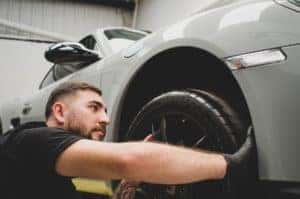
Image by Deniz Demirci is licensed with Unsplash License The detailing products you use on the exterior of your vehicle can make a significant impact on the outcome. Do use a high-quality shampoo specially formulated for vehicle exteriors. Don't use household cleaning products, such as dish soap or laundry detergent, as these are likely to strip the paintwork. One of the most overlooked cleaning agents is water. To ensure that your water remains clean as you detail your vehicle, heed these simple tips. First, do be mindful of your order of operations. Clean the wheels and tires first, as these are the dirtiest components of the exterior. Don't move on to the body before disposing of the water you initially used. While working on the body, do use two buckets — one containing the shampoo water, the other with plain water. Dunk your clean wash mitt into the shampoo bucket, wash your vehicle, and then rinse the mitt in the plain bucket before reintroducing it to the shampoo. This practice prevents contamination. When it's time to wax the body, do practice restraint. A little bit of wax should be all you need to get the job done. Don't overdo it. Using too much wax can leave streaks on the body, negating all of the work you put into creating an attractive exterior.

Detailing Tools

The tools you use contribute to the outcome as well. Do use soft materials for exterior detailing. In most cases, the best tool for the job is a car wash mitt, which provides a gentle surface for lifting away the dirt and grime on the body of your vehicle. Wash mitts are available in wool, microfiber, and synthetic materials. Wool and microfiber are the gentlest on paintwork, with microfiber generally being longer-lasting and more dirt-absorbent. Don't use a sponge. The composition of a sponge means it's more likely to push grime around rather than lift it off, resulting in unsightly swirl patterns on the body. Sponges can also be abrasive, causing fine scratches to form on the paintwork. For added protection of your bodywork, do consider using a grit guard. A grit guard is an object, typically made of plastic or metal, that you place in a bucket. It sits a few inches above the bucket's floor and helps separate the clean water from dirt and grime that has transferred from your wash mitt. Finally, be careful about your finishing tools. Do use soft towels for drying the vehicle, and don't let it air-dry, lest you leave watermarks on the body. Also, do use a buffer to polish the body, which promotes an even application and consistent result. Don't polish by hand unless you've mastered the art of manual application and shining.

Personal Practices

As the detailer, you can follow certain personal practices to ensure high-quality results from your efforts. For example, do wear soft clothes for the exterior detailing. Like a sponge, abrasive fabrics can rub against the paintwork and inflict very fine damage. In a similar vein, don't wear jewelry or zippered items, which can leave highly noticeable scratches on the paintwork. Remove rings, watches, necklaces, and similar objects and store them in a safe place while you carry out your detailing tasks. Also, do be mindful of where you're working. The ideal environment for detailing a vehicle is in a cool and shady area. You'll feel more comfortable as you perform the work, and it will be easier to avoid water spots that form when the surface of the vehicle is too hot. With that in mind, don't work when it's too hot outside. Either start your work at a cooler time of the day or, if possible, find a spacious indoor spot to complete your detailing. Finally, consider your methodology. Do begin with a gentle spray of the exterior to loosen any debris and finish with a hose-down to wash away any remaining particles. Don't neglect the nooks and crannies when you do this. Make sure to address the undersides, jambs, and deep crevices. Be careful with pressurized water, too. Don't focus the spray on a single area on the body, as this can embed dirt that may end up scratching the paintwork. Also, don't use overly hot or cold water. Warm water is ideal for exterior detailing. If you have any questions about detailing your vehicle — whether it concerns the products you use or the practices you follow — feel free to get in touch with us. Fill out the form on our contact page with your name, contact information, and message, and one of our associates will reach out to you. If you'd prefer to speak with someone directly, give us a call on 859-724-6956. Of course, you're always welcome to drop by the dealership at your earliest convenience. Find us at 2021 Iverson Drive in Paris, Kentucky. We're open six days a week — 8:30 a.m. to 8 p.m., Monday through Friday, and 8:30 a.m. to 6 p.m. on Saturday. While you're here, you can take a look at our inventory of new Chryslers, Dodges, and Jeeps, as well as our stock of pre-owned vehicles. Whatever you're looking for, let us be the ones to help you find it.
Posted in:

Related Posts

Car lot

When is The Best Time to Buy A Car?

Maybe it's about time to get a new (or new-to-you) car, but you'd also like to see if you can get a good deal. If you allow yourself for some preparation, you can avoid some common car-buying mistakes and land yourself a great deal at your favorite local dealership. View New Vehicles View Used Vehicles Here are tips from Dan Cummins Chrysler Dodge Jeep Ram of Paris, a full service dealership right in Paris, Kentucky, to help you decide on the best possible time to purchase that new car. Before It's an Emergency The best time to buy a car is before you already absolutely need it. Last-minute decisions can mean you buy what's available now as opposed to what you really want out of a vehicle. If you give yourself enough time to do thorough research, you'll be able to get your finances together and come up with a list of features you want in your vehicle of choice. Our team can then help get you into the best vehicle that truly fits your lifestyle. Toward the End of the Month Modern shiny cars near factory in daytime by Tom Fisk is licensed with Pexels License Oftentimes, dealerships will offer various discounts at the end of the month to help sales representatives meet their monthly sales goals. Sales representatives can often offer you additional savings or incentive programs to help you get into that new car by the end of the month. At the same time, though, each dealership has different quota policies, so some dealerships might offer these incentives at a different time. But no matter what, it can still potentially save you money during the financing process. Early in the Week There is a high chance of getting a good deal for a car purchase on a Monday (or even a Tuesday) because so many other potential customers already came in over the weekend. After that weekend rush is over, a sales representative can spend more time with you, getting to understand all of your needs. Just think about the fact that other people will also be car-shopping on major three-day weekends, so Tuesday is also a good choice. You'll still get that deeply individualized service that gets you the best deal on the vehicle you want. During a Three-Day Weekend We did mention that a lot of people shop for cars on three-day weekends, and there's a good reason why. Whether the holiday falls on a Friday or a Monday, car dealerships offer matchless promotional deals and amazing incentives during these long weekends. The four most popular three-day weekends for car deals are Labor Day, Memorial Day, President's Day, and the 4th of July. Labor Day and Memorial Day weekends usually have the best combinations of promotional prices and vehicle selections, but President's Day and Independence Day offer good price reductions, too. We recommend visiting our showroom earlier in the week to narrow down your options, get some questions answered, and test drive your favorites. Then you're prepared to buy right away when those deals activate over the weekend. During Black Friday Black Friday is one of the biggest consumer holidays for nearly every industry. As a result, car dealerships often take advantage of this customer mindset of shopping for the best deals to provide huge discounts on major models to increase their sales. The dealership is thinking ahead to their year-end sales targets and wanting to clear out excess stock before any model refreshes, so sales teams are motivated to move inventory. Just like with those three-day holiday weekends, we recommend planning way ahead of Thanksgiving. Start your research earlier in the month, and feel free to ask our team any questions while you test drive what we have in stock before you clinch the deal. At the End of the Calendar Year Even after Black Friday ends, you can still see a good amount of discounts at your local dealership through the month of December. Dealers are looking hard at those end-of-year targets by now, and they can offer incentives, deep discounts, and extra amenities to help you get the car you're looking for as well as secure higher sales figures. Data shows that December is one of the cheapest months to purchase a vehicle, as sellers are pushing to close their deals before New Year's Day. At the End of the Model Year Manufacturers usually release a new model every year, so when the new model comes into the store, dealers work to reduce their stock of older models and trims to make room. This tends to happen during the end of summer and into the start of fall. Having the newest editions in stock means that last year's model now has a lower level of demand — as well as price. So if you're looking for a newer vehicle but don't necessarily need the most recent model year, this is a good option for you. Be sure to compare any new features to the outgoing model before you close the deal. The more updated the features are in the refreshed model, the greater of a discount you'll most likely see. When a Car Is About To Be Redesigned or Discontinued Vehicle models don't always change that much from one year to another. But sometimes, a new model year brings with it a total redesign of a given vehicle, from the exterior shape to the array of interior features. When this is happening for a car brand that you love, you can treat this just like you would the end of a regular model year. You can snap up the previous design for a significantly lower sticker price than the newest release. Also, sometimes entire model lines get discontinued, maybe to make room for something totally new or because that model wasn't very popular. Either way, keep an eye on any advertising that says a particular model is going to be discontinued.  You'll be able to get substantial discounts and even financing deals so that the dealership can clear it out. No matter when you decide to take advantage of these deals, be sure to prepare in advance. Research all of your options, and get in touch with our financing department to see what options you have. We'll be glad to help you get into the vehicle that's best for your needs.

2022 Jeep Compass Interior

Does My AC Use Gas In My Vehicle?

Paris residents know that Kentucky is no stranger to warm summers. You're likely blasting your car's A/C as you drive around exploring our town's iconic wineries and museums. But as pleasant as the cool air feels, the little voice inside your head might be telling you that you're wasting gas. Many people believe that the A/C is a gas guzzler, and considering how high fuel costs are, you want to save in every way you can. Here at Dan Cummins Chrysler Dodge Jeep Ram of Paris, we're here to further investigate this common claim. Read on to learn how your car's A/C unit works and whether it consumes as much gas as people would like you to believe. We also discuss whether it's more fuel efficient to roll down the windows, share other ways to save on gas, and explore the fuel requirements of a car heater. View All New Vehicles View All Used Vehicles How a Car A/C Works 2022 Jeep Compass Interior Before we elaborate on the fuel usage of a car's A/C unit, it's worth exploring how these units operate. Understanding the function of each component can help you better appreciate what's necessary for it to work. Know that the A/C units in most vehicles have more or less the same parts and run on refrigerant, a high-pressure gas. Here's a closer look at the main components across the majority of makes and models: Compressor: As its name suggests, a compressor compresses the refrigerant into a fluid. This compressed refrigerant then flows through a line to reach the condenser. Condenser: The condenser receives the fluid refrigerant from the compressor and removes heat from the liquid. The cool fluid then moves to the expansion valve. Expansion valve: Also known as the orifice tube, the expansion valve is where the refrigerant returns to its original gaseous state. The expansion valve pushes this gas to the receiver. Receiver: While some people refer to it as the drier or accumulator, the receiver's purpose is the same regardless of its name. This component removes excess moisture from the refrigerant and transfers it to the evaporator. Evaporator: The evaporator pulls the refrigerant from the receiver and absorbs the heat from the gas passing through its core. The resulting cold air flows through your vehicle and keeps you cool on the hottest Paris days. Does a Car's A/C Use Gas? Now that you know how a car's A/C unit works, you likely won't find it surprising that it uses gas. Its operation adds a load to the engine, requiring it to work harder than it would if you had the A/C off. However, it's important to note that the A/C unit's load on the engine is relatively slight. The amount of gas it uses isn't noticeable to most consumers, so feel free to turn it on as you please. Keeping your car cool is worth the minuscule cost. When you and your passengers are comfortable, you'll experience safer and more enjoyable rides throughout Paris. Should You Roll Down the Windows Instead of Using the A/C? Even though a car's A/C unit doesn't significantly impact your fuel mileage, you might still look for ways to keep it off. Some budget-conscious drivers wonder if rolling down the windows can help them save. In fact, this approach can actually decrease your fuel mileage more than turning on the A/C would. Rolling the windows down causes your car to become much less aerodynamic and forces the engine to work harder. So, while you might enjoy the cool breeze, you likely won't notice any gas mileage improvements, and your fuel costs might even increase. However, rolling your windows down while driving at slower speeds around town might minimize the drag enough to prevent it from affecting your fuel economy. Nevertheless, keeping your windows up and the A/C on may be best, especially when driving at high speeds on the highway. It's a win-win across the board, as you'll get to optimize your fuel mileage and enjoy the benefits of a closed cabin. After all, many drivers don't want to deal with the loud rush of wind, bugs, or summer rain. Does a Car's Heater Use Gas? After learning about the fuel consumption of an A/C unit, it's only natural to wonder if a car's heater uses gas. The answer is similar in that the fuel consumption is negligible. The engine naturally creates heat as it operates, and this heat either leaves the car through the exhaust pipe or redirects to the coolant that flows within the vehicle's HVAC system. The system's internal fan spins and distributes warm air throughout the cabin with the help of electricity, which relies on fuel consumption. Again, the usage is so minimal that turning on your heater is worth it. There's no alternative like rolling down the windows, as you'll only let cold Paris air into your cabin. The heater keeps you and your passengers comfortable during our frigid winters. Tips for Being More Fuel Efficient Your car's heater and A/C unit use trivial amounts of fuel and keep your passengers comfortable. So, instead of leaving these systems off, use the following tips to be more fuel efficient: Inflate your tires to the manufacturer's recommended levels. Properly inflated tires decrease rolling resistance, which can improve your fuel economy. Shut off your engine when stopping for more than a minute. Preventing unnecessary idling can help you prevent excessive fuel consumption. Maintain your vehicle. Regular maintenance, according to the manufacturer's recommendations, can help your car operate more efficiently over extended periods. In short, your car's A/C unit uses minimal fuel. You won't see significant savings by turning it off or rolling down the windows. Feel free to blast cool air and keep your passengers comfortable. Use the other tips we've provided to improve your car's fuel economy and save the money you want. If you want to become even more fuel efficient, contact one of our representatives to learn about buying an economical vehicle.

RAM 1500 Towing

2026 RAM 1500 Engine Guide: Hurricane vs. Pentastar | Paris, KY

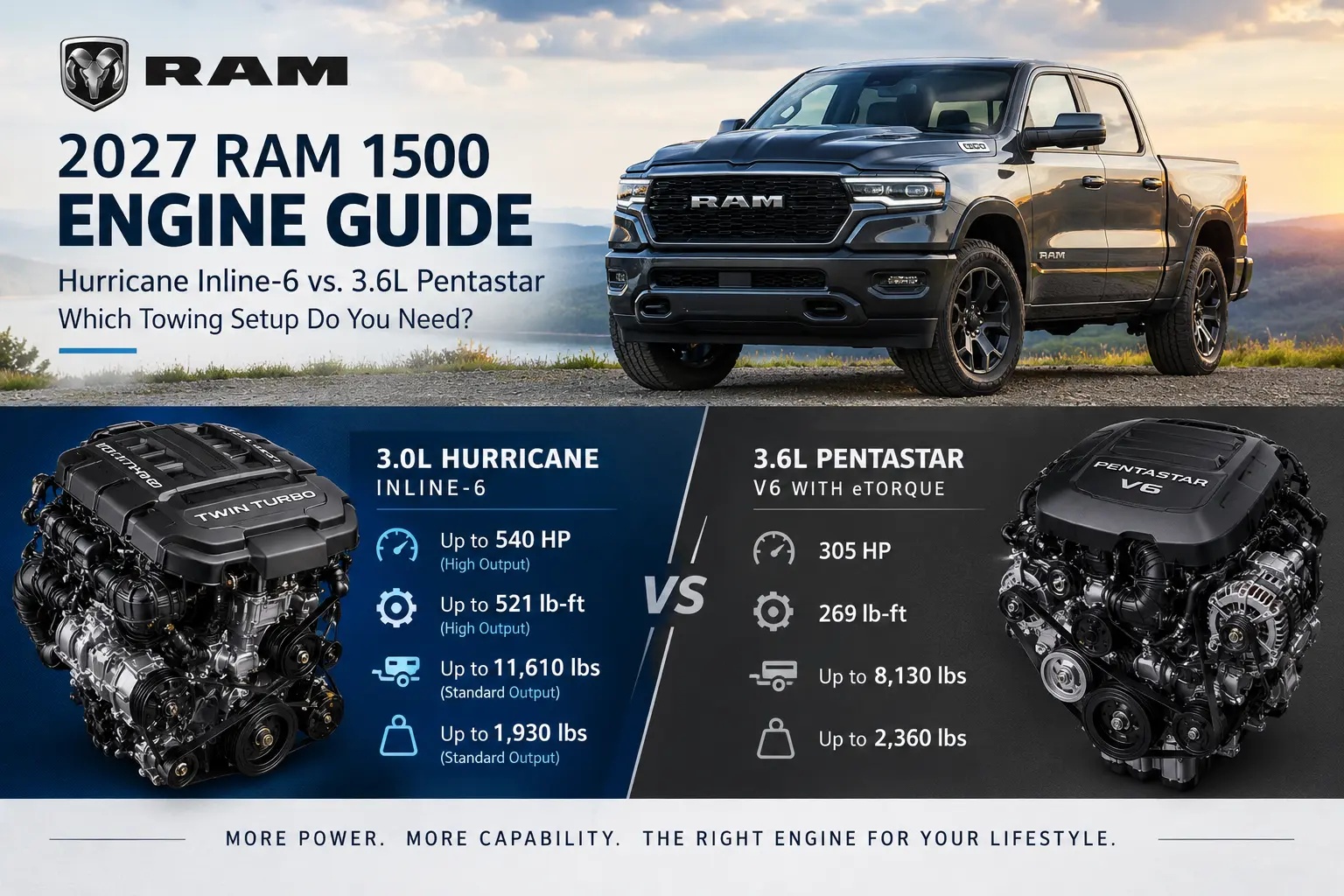
RAM 1500 Engine Guide: Hurricane Inline-6 vs. 3.6L Pentastar (Which Towing Setup Do You Need?) Choosing the right pickup truck engine can make a major difference in towing performance, everyday drivability, fuel economy, and long-term ownership costs. For drivers shopping for a 2027 RAM 1500, two engine options deserve a closer look: the proven 3.6L Pentastar V6 with eTorque and the powerful 3.0L Hurricane Twin-Turbo Inline-6. Whether you're hauling equipment to a job site, pulling a camper toward Cave Run Lake, towing a boat for a weekend getaway, or looking for a dependable truck for everyday driving around Paris and Lexington, Kentucky, understanding the differences between these engines can help you make a more confident decision. At Dan Cummins CDJR of Paris, we're helping truck shoppers find the right combination of power, capability, comfort, and value. Here's what you need to know about RAM 1500 Hurricane engine specs, towing capacity, payload, and which powertrain best fits your lifestyle. 2027 RAM 1500 Engine Comparison: At a Glance The 2027 RAM 1500 offers several powertrain choices, including the Pentastar V6 and two versions of the Hurricane Inline-6. Each engine delivers a different balance of horsepower, torque, towing capability, and payload capacity. Engine specification 3.6L Pentastar V6 with eTorque 3.0L Hurricane Standard Output 3.0L Hurricane High Output Engine configuration V6 Twin-turbo Inline-6 Twin-turbo Inline-6 Horsepower 305 hp 420 hp 540 hp Torque 269 lb-ft 469 lb-ft 521 lb-ft Maximum towing capacity 8,130 lbs 11,610 lbs 10,000 lbs Maximum payload 2,360 lbs 1,930 lbs 1,490 lbs Best suited for Daily driving and payload-focused work Heavy towing and versatile truck use High performance and off-road driving Specifications represent published maximums for the 2027 RAM 1500 lineup. Actual towing and payload ratings vary by cab, drivetrain, trim, axle ratio, equipment, and vehicle configuration. These maximum ratings are not necessarily available together on the same truck. Understanding the 3.6L Pentastar V6 with eTorque Not every truck owner needs maximum horsepower or the biggest available engine. For many drivers, the 3.6L Pentastar V6 provides a practical combination of everyday performance, payload capacity, and efficiency. What does the Pentastar V6 offer? The 3.6L Pentastar V6 with eTorque produces: 305 horsepower for everyday driving and light-duty hauling. 269 lb-ft of torque to support acceleration and routine work. Up to 8,130 pounds of towing capacity when properly equipped. Up to 2,360 pounds of payload capacity in qualifying configurations. The eTorque mild-hybrid system adds electrical assistance to selected engine operations, including start-stop functionality and supplemental torque during certain driving conditions. This can help the truck feel more responsive when pulling away from a stop or navigating changing traffic conditions. Who should choose the Pentastar V6? The Pentastar makes sense for drivers who spend most of their time commuting, carrying passengers, transporting tools, or loading materials into the truck bed. For example, a contractor who regularly carries lumber, toolboxes, and other supplies may benefit from prioritizing payload capacity rather than choosing an engine based solely on horsepower. Likewise, someone who occasionally tows a smaller utility trailer may not need the additional output of a twin-turbo engine. The key is understanding the difference between towing and payload. Towing capacity measures how much a truck can pull, while payload measures how much weight the truck itself can carry. Passengers, cargo, accessories, and applicable trailer tongue weight all factor into payload calculations. If your truck spends more time carrying supplies than pulling a large trailer, a properly equipped Pentastar model may be worth considering. RAM 1500 Hurricane Engine Specs: More Power and Torque For drivers who regularly tow heavier trailers or want stronger acceleration under load, the 3.0L Hurricane Twin-Turbo Inline-6 offers a substantial increase in output. The Hurricane engine family uses twin turbochargers to produce impressive horsepower and torque from a relatively compact six-cylinder design. Rather than relying on a traditional naturally aspirated V8, these engines use forced induction to deliver strong performance across a broad range of driving situations. The 2027 RAM 1500 offers two versions of this engine: Standard Output and High Output. 3.0L Hurricane Standard Output: The towing-focused choice The Standard Output Hurricane delivers: 420 horsepower 469 lb-ft of torque Up to 11,610 pounds of towing capacity Up to 1,930 pounds of payload capacity For many truck buyers, this is the sweet spot in the RAM 1500 lineup. Compared with the Pentastar V6, the Standard Output Hurricane adds 115 horsepower and 200 lb-ft of torque. That extra torque can be particularly useful when accelerating with a trailer, climbing grades, or carrying a substantial load. Its published maximum towing capacity is also significantly higher than the Pentastar's maximum rating. Consider a Central Kentucky homeowner who regularly pulls a travel trailer, transports a side-by-side, or hauls a loaded equipment trailer. The Standard Output Hurricane offers the additional capability that may make those jobs easier, provided the specific truck's ratings meet the requirements of the trailer. Best for: Drivers who want a versatile truck for commuting, job-site work, recreational towing, and occasional heavier hauling. 3.0L Hurricane High Output: Performance without compromise The High Output Hurricane is engineered for drivers who prioritize maximum engine performance. Its specifications include: 540 horsepower 521 lb-ft of torque Up to 10,000 pounds of towing capacity Up to 1,490 pounds of payload capacity With 235 more horsepower than the Pentastar V6, the High Output Hurricane delivers a dramatically different driving experience. It is designed for shoppers who want exceptional acceleration and high-performance capability. This engine is associated with performance-oriented RAM 1500 models, including the RHO, and is also available in select premium configurations. The important detail for towing shoppers is that the High Output Hurricane does not have the highest maximum towing rating in the lineup. Its maximum published rating is 10,000 pounds, while the Standard Output Hurricane can reach 11,610 pounds in qualifying configurations. Why? Towing capability depends on more than horsepower. Payload limits, vehicle weight, suspension, axle configuration, and other engineering considerations all affect the final rating. Best for: Drivers who value high horsepower, performance-oriented driving, and the specialized capabilities of models such as the RAM 1500 RHO. Which RAM 1500 Engine Has the Highest Towing Capacity? If your primary objective is to tow the heaviest possible trailer with a 2027 RAM 1500, the 3.0L Hurricane Standard Output offers the highest published maximum towing capacity among the three engines compared here: up to 11,610 pounds. However, the truck with the most horsepower is not automatically the best truck for towing. Here's how to approach the decision: Choose the Pentastar V6 if your towing requirements are modest and you value a strong payload rating in a properly equipped truck. Choose the Standard Output Hurricane if you frequently tow heavier campers, boats, enclosed trailers, or work equipment. Choose the High Output Hurricane if high-performance power is a priority and its specific towing and payload ratings meet your needs. Before purchasing, determine the fully loaded weight of your trailer, not just its advertised dry weight. Include passengers, luggage, equipment, and other cargo. For fifth-wheel or conventional trailers, account for the weight transferred onto the truck. You should also verify the specific vehicle's maximum trailer rating, payload label, gross vehicle weight rating, gross combined weight rating, and hitch limits. These details matter because a truck rated to tow a particular weight may reach its payload limit before reaching its maximum trailer rating. Payload vs. Towing: Which Number Matters More? This is one of the most important questions to answer before choosing your next RAM 1500. Imagine two drivers with very different needs. Driver A: The contractor This driver carries several passengers, a toolbox, power equipment, and construction materials. The trailer is relatively light, but the truck bed and cab regularly carry significant weight. For this driver, payload capacity may be the limiting factor. A properly configured Pentastar model could be a strong candidate, depending on the actual load. Driver B: The camper owner This driver pulls a large travel trailer on weekend trips and carries relatively little cargo in the truck itself. For this driver, the Standard Output Hurricane may be attractive because of its higher maximum towing rating and substantial torque. Neither situation has a universal answer. The best choice depends on the actual weights involved and the specific truck configuration. At Dan Cummins CDJR of Paris, our team can help you compare available RAM 1500 configurations and identify the ratings that matter for your intended use. Is the RAM 1500 Comfortable Enough for Everyday Driving? A truck can be capable without feeling harsh on the road. That's one reason the RAM 1500 deserves consideration from drivers who use their pickup for both work and everyday transportation. How RAM's rear coil suspension helps. The RAM 1500 uses a rear suspension design that has historically helped distinguish it from many competing full-size pickups. Its rear coil-spring suspension helps provide a controlled, composed ride, particularly when the truck is unloaded. Depending on the model, buyers can also find specialized suspension setups and available four-corner air suspension. For drivers commuting between Paris, Nicholasville, and Lexington, ride comfort can make a real difference. The truck may be used for work during the week, family transportation in the evening, and recreational travel on the weekend. The right configuration balances ride quality with the truck's intended workload. Remember that suspension design does not eliminate payload restrictions, and heavy cargo or trailer tongue weight can change how a truck behaves on the road. What about fuel economy? Engine choice affects fuel consumption, but the comparison isn't as simple as assuming that a smaller engine always saves fuel. The 2027 RAM 1500's published 4x2 estimates illustrate the difference: 3.6L Pentastar V6: Up to 20 mpg city and 25 mpg highway. 3.0L Hurricane Standard Output: Up to 18 mpg city and 25 mpg highway. These are manufacturer-estimated maximums for qualifying 4x2 configurations, not guaranteed real-world results. Four-wheel drive, trim, tires, cargo, towing, driving habits, and road conditions can all affect fuel economy. When towing, fuel consumption typically increases. A driver who regularly pulls a heavy trailer may prefer the Hurricane's additional torque even if the actual fuel savings or penalty depends on the use case. The Hurricane also demonstrates how modern turbocharged engines can deliver substantially more output than an older-style, naturally aspirated engine of comparable displacement. However, the right comparison should account for the exact model year, configuration, and driving requirements rather than assuming every Hurricane configuration is more fuel-efficient than every V8. Hurricane vs. Pentastar: Which Engine Is Right for You? If you're still deciding, start with how you will use the truck most often. Your primary need Engine to consider Why Daily commuting and errands Pentastar V6 Balanced everyday performance Carrying tools and supplies Pentastar V6 or Hurricane Standard Output Compare actual payload ratings Regular camper or boat towing Hurricane Standard Output Higher maximum towing rating Frequent towing on hilly routes Hurricane Standard Output Substantially higher torque than the Pentastar High-performance driving Hurricane High Output 540 horsepower and 521 lb-ft of torque Off-road performance RHO or another suitable off-road configuration Match suspension, tires, drivetrain, and engine to the terrain Use this table as a starting point rather than a final specification sheet. Available engines and ratings depend on trim and configuration. Find Your Next RAM 1500 at Dan Cummins CDJR of Paris Whether you're shopping for a capable work truck, a comfortable daily driver, or a powerful pickup for towing recreational equipment, choosing the right engine is an important first step. At Dan Cummins CDJR of Paris, we can help you explore available RAM 1500 models, compare engine options, and identify a configuration that fits your towing and payload requirements. Our location in Paris, Kentucky, makes us a convenient destination for shoppers throughout Bourbon County and drivers traveling from Lexington and surrounding Central Kentucky communities. When you're comparing trucks, bring the details of your trailer or typical cargo load. Knowing what you plan to tow, how often you'll tow it, and how many passengers you normally carry can help narrow the options considerably. Ready to find a RAM 1500 for sale near Paris, KY? Explore our available inventory, compare RAM 1500 configurations, and contact Dan Cummins CDJR of Paris to discuss which engine and towing setup best fits your needs. Your next truck should be built around the work you do and the adventures you want to take, not just the biggest number on a specification sheet. Frequently Asked Questions Which 2027 RAM 1500 engine is best for towing? The best engine depends on your trailer weight, payload requirements, and truck configuration. The 3.0L Hurricane Standard Output Inline-6 is an excellent option for drivers who prioritize towing capability, while the 3.6L Pentastar V6 may suit lighter-duty towing and everyday hauling. Always verify the maximum towing rating for the specific 2027 RAM 1500 you're considering. What is the maximum towing capacity of the RAM 1500? Maximum towing capacity varies by model year, engine, trim, drivetrain, cab configuration, and equipment. For reference, the 2027 RAM 1500 with the 3.0L Hurricane Standard Output engine offers a published maximum towing capacity of up to 11,610 pounds in qualifying configurations. Confirm the official 2027 specifications before selecting a truck for your towing needs. What is the difference between the RAM 1500 Hurricane and Pentastar engines? The 3.0L Hurricane is a twin-turbocharged Inline-6 designed to deliver significantly more horsepower and torque than the 3.6L Pentastar V6. The Pentastar with eTorque emphasizes practical everyday performance and can offer a higher maximum payload rating in qualifying configurations. Your best choice depends on whether you prioritize towing, carrying cargo, performance, or daily driving. Is the RAM 1500 Hurricane engine better than the Pentastar for everyday driving? Both engines can work well for everyday driving. The Pentastar V6 is a practical choice for commuting, errands, and lighter-duty work, while the Hurricane provides additional power for drivers who want stronger acceleration or regularly carry heavier loads. Consider your typical driving conditions, expected fuel consumption, and towing requirements before deciding. Which RAM 1500 engine gets better gas mileage? Fuel economy depends on the engine, drivetrain, trim, tires, and driving conditions. A smaller engine does not automatically deliver better real-world fuel economy in every situation. Towing, heavy cargo, highway speeds, and frequent acceleration can substantially affect mileage. Compare the official EPA estimates for the exact RAM 1500 configurations you're considering. What is the difference between RAM 1500 towing capacity and payload capacity? Towing capacity is the maximum weight a properly equipped truck is rated to pull. Payload capacity is the total weight the truck can carry, including passengers, cargo, accessories, and applicable trailer tongue weight. A truck can reach its payload limit before reaching its maximum towing capacity, so both ratings are essential when choosing a towing setup. Is the RAM 1500 comfortable enough to use as a daily driver? Yes. The RAM 1500 is known for its composed ride quality, supported by its rear suspension design. Depending on the configuration, drivers may also have access to additional comfort-oriented features and available air suspension. This makes the RAM 1500 worth considering for drivers who want a truck that can handle work responsibilities while remaining comfortable for commuting and family travel. Where can I find a RAM 1500 for sale near Paris, KY? Dan Cummins CDJR of Paris offers RAM truck shoppers an opportunity to explore available inventory and compare configurations. Whether you're shopping from Paris, Lexington, or another Central Kentucky community, our team can help you identify a RAM 1500 that fits your towing requirements, payload needs, and budget. Browse our available RAM 1500 inventory or contact our dealership to discuss your options.